
Expanding 20-30 Miles: Why a Bigger "Local" Can be a Small Business Superpower
Expanding 20–30 Miles: Why a Bigger “Local” Can Be a Small Business Superpower
You don’t build wealth by gambling, you build it with a well-balanced investment strategy. Think of your marketing the same way.
For many small local companies, “growth” sounds like a scary word in an economy that keeps changing its mind. Customers are price-sensitive, costs remain sticky, and headlines can flip from “soft landing” to “uh-oh” in a single news cycle. Even when the broader economy looks “solid,” consumers can still feel cautious about spending.
That’s exactly why expanding your reach by a modest 20–30 miles can be such a smart move. It’s not a leap into the unknown. It’s a widening of your existing circle.
1) A 20–30 mile expansion is often a 2–4x market increase (without changing what you sell)
A radius change is not linear, it’s geometric. Service areas expand like ripples: doubling the radius roughly quadruples the area. Even if real-world demand isn’t evenly distributed (it isn’t), the math tells you something important: a slightly bigger “local” can mean dramatically more potential customers.
This matters in uncertain conditions because it reduces dependency on one area’s mood. If a nearby town or county has new housing, a growing employer, or simply more foot traffic, your business can benefit without reinventing itself.
2) Consumers are already searching beyond your current borders
People increasingly shop and book services through local search, especially on mobile. “Near me” behavior is huge, and local searches frequently convert into real-world purchases. Some compilations of local-search research cite hundreds of millions of “near me” searches monthly and note that a meaningful share of local searches result in purchases.
A bigger radius lets you appear in more “near me” moments. It also lets you target commuters and “in-between” customers: the folks who live in one town, work in another, and buy wherever it’s convenient that day.
3) Expansion hedges against today’s cost and confidence whiplash
Recent reporting shows small businesses still rank inflation and cost pressures as top concerns, even when owners feel cautiously optimistic about revenue growth. When households feel uncertain, they comparison-shop harder and delay non-urgent purchases.
A wider footprint helps you respond in three practical ways:
Diversification: Demand soft in one pocket? Another pocket may be fine.
More efficient routing and scheduling: For service businesses, denser routes across a larger map can increase revenue per day.
Pricing power through positioning: If you become “the” trusted option across multiple towns, you compete less on price alone.
4) Professional PR and advertising make the radius “feel smaller”
Here’s the catch: expanding your map without expanding your reputation is like opening a new door with no sign on it.
This is where professional support matters. A strong PR and advertising partner helps you:
Translate your story for new communities why should this community write about you? (why you, why now, why they should care)
Build credibility fast through local media, community partnerships, reviews strategy, and events
Avoid wasted ad spend by tightening targeting, messaging, and measurement
Trust is the currency of expansion, and earned credibility is often more persuasive than paid promotion alone. Nielsen’s long-cited research found 92% of people trust recommendations from friends and family more than advertising. Edelman’s research also emphasizes that trust in brands people use is high, and that consumers are looking to brands for stability and “economic hope” amid uncertainty. A PR pro’s job is to turn your business into the obvious, safe choice in unfamiliar zip codes.
5) What to budget for a 6–12 month expansion campaign (as % of sales)
For a serious 20–30-mile push, plan on a 6–12 month campaign so you can test, learn, and compound results.
A practical benchmark is 7–10% of revenue, with flexibility based on how aggressive your goals are:
Around 7.7% of revenue is a widely cited average marketing budget level in Gartner’s CMO Spend Survey reporting.
Many small-business budgeting guides suggest 5% to 20% of revenue depending on growth stage and goals.
A common split for an expansion campaign:
40–60% paid media (local search ads, social, retargeting, possibly streaming audio)
20–30% PR and content (media outreach, community partnerships, storytelling assets, reputation management)
10–20% creative + measurement (landing pages, tracking, call attribution, reporting)
10% “test fund” (new channels, seasonal pushes, sponsor opportunities)
Done well, expanding your radius isn’t “going big.” It’s going wider in a controlled way, using professional PR and advertising to make new customers feel like you’ve been their local favorite all along.
A Practical Budget Example: What Expansion Really Looks Like
Imagine a family-owned company generating $3 million in annual sales. Based on widely cited industry benchmarks, a business at this stage should already be investing approximately 7–10% of revenue into marketing, or $210,000 to $300,000 per year, to maintain brand visibility and competitive positioning. If the company chooses to expand its reach by 20–30 miles into adjacent markets, a realistic approach is to allocate an additional 2–3% of revenue specifically for expansion efforts, or $60,000 to $90,000 annually. This brings the total marketing investment to roughly $270,000 to $390,000 per year during a 6–12 month expansion campaign.
That expansion budget could be strategically allocated as follows: $30,000–$45,000 for targeted digital advertising and local search campaigns in new zip codes, $15,000–$25,000 for professional PR, local media placements, community sponsorships, and reputation-building efforts, $10,000–$15,000 for creative assets such as landing pages, video, and localized messaging, and $5,000–$10,000 for analytics, call tracking, attribution, and controlled testing of new channels. Even a conservative lift of 3–5% in annual revenue from new markets would represent $90,000–$150,000 in additional sales, making the expansion both defensible and scalable in uncertain economic conditions.
A Balanced “Middle-Ground” Example Budget
Let’s look at a smaller budget of $100,000. For many small and mid-sized businesses, a balanced approach might breakdown like this:
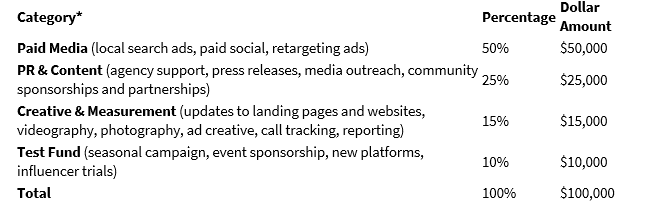
This structure provides:
Strong visibility
Credibility and trust
Data-driven optimization
Built-in adaptability
Why This Matters in Uncertain Times
In volatile economic conditions, the goal is not just “spend and hope.” It’s deploy and adapt.
*A $100,000 budget used this way behaves more like a portfolio than a gamble:
Paid media delivers short-term results
PR builds long-term brand equity
Measurement protects against waste
Testing creates future opportunities
Professional guidance ensures these pieces reinforce each other rather than compete for attention or seem disjointed. The result is not louder marketing, but sharper marketing. And sharp tools, properly wielded, cut through uncertainty with remarkable efficiency.
CASE STUDY:
Winning New Customers Without Increasing the Budget, But Instead, Shifting the Focus
Professional support does not always mean spending more. In some cases, it means spending smarter and extracting more value from every dollar already committed. A strong example comes from a Hudson Valley–based garden and furniture center that wanted to expand into a neighboring county without increasing its annual marketing budget. By working with GMG Public Relations, we were able to assist the business owner in reframing how their existing dollars were used, shifting away from broad, awareness-only, one-county tactics toward more strategic messaging aimed at the specific type of buyer most likely to purchase higher-margin plants, landscaping materials, and seasonal goods in a neighboring county.
With sharper audience targeting, stronger consistent storytelling, and better alignment between PR, local visibility, social media, and advertising, the nursery began attracting shoppers who had always been within driving distance but simply didn’t know the business existed or what they offered. The result was not just successful entry into a new market, but sustained performance: the company has grown revenue every year for the past seven years, including through COVID disruptions and ongoing economic uncertainty.
The lessons are clear.
1) Small Geographic Moves Can Create Big Growth Opportunities
Expanding just 20–30 miles can dramatically increase your potential customer base without changing your products, services, or business model. Because market area grows geometrically, even modest expansion can unlock two to four times more opportunity, making “going wider” one of the most efficient growth strategies available to small businesses.
2) Today’s Customers Are Already Looking Beyond Your Borders
Modern consumers rely heavily on mobile search, maps, and “near me” queries, meaning they are often willing to travel across town lines for trusted providers. Businesses that limit their visibility to a single community risk missing out on customers who are actively searching nearby but never see their name.
3) Expansion Builds Stability in Uncertain Economic Conditions
A wider service area helps protect against localized slowdowns, shifting demographics, and changes in consumer confidence. By diversifying demand, improving operational efficiency, and strengthening brand positioning, small businesses can reduce their vulnerability to inflation, rising costs, and sudden market shifts.
4) Professional PR and Advertising Turn Awareness into Trust
Growth is not just about being seen, it is about being believed. Professional support helps businesses enter new markets with credibility, consistency, and clarity, strengthening their brand position. By aligning paid media, PR, content, and reputation management, companies can avoid wasted spending and become the “safe choice” in unfamiliar communities.
5) Smart Budgeting Outperforms Bigger Spending
Successful expansion is driven by strategic allocation, not just higher budgets. Regardless of the size of the marketing budget, businesses that balance paid media, PR, creative, analytics, and testing are better positioned to adapt, optimize, and compound results. Treating marketing like a well-balanced investment strategy rather than a gamble leads to stronger returns and long-term resilience.
We’re celebrating 35 years of helping companies and nonprofits expand into new markets. Call me and let’s figure out how to expand your reach! 914-996-8100, Ext. 1. risa@gmgpr.com